7/10/08

Foot 4 Thought, Part Six Revised

Don't like your feet? What to do. The latest craze? Nip and Tuck. Cut and paste. Simply put, knives. While surgery is helpful in correcting certain foot claws, I mean flaws, the cutting edge, pardon the pun, is slicing and dicing for beauty.

Podiatrists and Orthopedics are not all in agreement. While most do not agree with cosmetic foot surgeries, a growing number are embracing the possibilities. Is that greed or need?

Some of these medical professionals contend that if it helps people feel less self-conscious, then it is worth the risk. One such person is Dr. Stuart Mogul, a podiatrist. Twenty percent of his patients have surgery to change the appearance of their feet.

Mogul states, My practice was traditionally, if it doesn't hurt, we are not fixing it, but I had patients that were really stressed out over aesthetic foot problems. I went ahead and repaired some and they did great. They were happy.

On the other side are surgeons like Dr. Nancy Kadel.

The danger is people are starting to view foot surgery as similar to having a pedicure, said Dr. Nancy Kadel, an orthopedic surgeon at the University of Washington Medical Center.

It's really a lot more involved. There are lots of little nerves in your foot, and surgery doesn't always turn out perfectly. Walking puts three times your body weight across your ankle and foot joints. Any little problem can really be magnified comments, It's really a lot more involved. There are lots of little nerves in your foot, and surgery doesn't always turn out perfectly.

Remember each foot has 26 bones, 30 joints, along with tendons and nerves. Talking about complex. And don't forget the vast amount of pressure the foot absorbs. No wonder the risks are higher.

The Debate?

Is it surgery reconstruction or purely cosmetic surgery? Are they the same? Some say yes. Others clearly make the distinction. One is for functionality in life. The other is for what appeals to the eye. Semantics. Semantics. Obviously, there are situations that make good health sense to opt for surgery. Bunions might be an example. Coupled with that might bring aesthetics into the equation. So you get a better looking foot. I, for one, sure wouldn't say to my surgeon, Just make sure you make my foot look uglier while you are taking care of my health issue. Why aren't we looking at common sense? At balance?


Just to Name a Few Procedures

  • Liposuction for the belly is now for the feet. Some people want slimmer ankles. Higher arches. Shapely feet.
  • Toes shortened to make the foot smaller or to shorten the second toe (by the way 1/3 of the population have a longer second toe).
  • Botox injected into the ball of the foot to relieve the pain of wearing stilettos.
  • Collagen and silicone are used as injections as well.
  • Face-lifting has now found its way into FOOT-LIFTING.

Possible Problems After Surgery

  • Deformities may develop later.
  • Botox can stop pain to the point of the person not having the sensation when they need it to protect themselves. Receptors damaged.
  • Loss of toes when blood supply is cut off.
  • Scarring. It is harder to mask a scar on the foot than other parts of the anatomy.
  • Infection.
  • Poor healing.
  • Inadvertent injury.
  • The problem recurs and or creates yet another problem.

While some surgeons are reporting that half of their patients request cosmetic surgeries, other surveys show that when asking consumers, only about 26% say they would consider such a procedure (WebMD Heath News).

The AOFAS, American Orthopaedic Foot and Ankle Society stated that the risks of cosmetic surgery outweighed the benefits. The APMA, American Podiatric Medical Association has not taken a stand against cosmetic surgery. Basically, it sounds like the APMA's position is that with any surgery comes risk, whether cosmetic or reconstruction. I would say that would make sense. But, we can't deny the two are for vastly different reasons.

So what is it worth to have beautiful feet? And who decides what that looks like? The media? The eyes of the beholder?
I'm not trying to be an alarmist. But all too often we don't look at the cautions before we proceed. As someone once said, one in one thousand doesn't seem like a big deal, until you are that ONE.

When is Enough Enough?

Recently while taking a rehab course, the presenter shared his experience with a lady who had surgery to correct an issue caused by high heels. As soon as she rehabbed, you got it, the stilettos were back on.

What causes us to have an insatiable desire to rip into our bodies for an air-brushed look? Again, how far have we evolved in this 21st century? Are we really so different from the days of foot binding?

What do we do with self-conscious, esteem, worth issues that clearly plague certain people? I was a lay counselor for seven years, so I am sensitive to these concerns. However, I wonder how much power should we let society's standards of beauty control our lives. How I long for the day when we no longer base our self-worth as women by the size of our breasts, our shapes, our smiles, our aging bodies, and now our feet. Let freedom ring, ladies.

NEXT: Part Seven in the Foot Series

Resources: Web MD Heath News; Seattle Post-Intelligencer; New Image.com; Medical News Today; American Academy of Orthopedic Surgeons 71st Annual Meeting March 11-14, 2004; 2008 ISP Course with Stott Pilates; Fix Your Feet-Dr. Philip Maffetone.

Copyright © 2008 by Ellen M. Samples. All rights reserved.

7/8/08

How Many Times Do I Have 2 Tell U?

Did you know muscles have memories? If you read the
Body Awareness Series (5/7/08) you may remember that discussion.

Too, did you know that you can change your muscles' memories? Probably.

How? Great question. It's called muscle-talk. Yes, I said talk to your muscles. And they will talk back, respectfully so.

Muscles are like your children, husband, wife. You can't just tell them something once. Don't we wish!
But is it the same? Not quite. Then again.

Seriously, studies show that it takes a whopping 50,000 times. Yes, I said fifty thousand; that's with four zeros. Fifty-thousand times before your muscle will adjust to what you've told them. Amazing. Is that possible in a lifetime? And what happens if you make it to 25,000? I need to quit asking such preposterous questions. Note, a presenter gave this stat at a rehab course June '08, and I'm still looking for the resource he used.

The bottom line is we can retrain our muscles. We can bring them into alignment. We can teach them to behave as they should. Is it work. Absolutely. As is anything that is valuable. It is so worth it.

Am I counting? I gave up around 4,000. Counting, that is. Everyday is an opportunity to retrain my body. As is it yours.
NOTE: Stay Tuned for the next post on the Foot Series!

Copyright © 2008 by Ellen M. Samples. All rights reserved.

7/4/08

Shoes For The Independent, Part Five


This sweet little gal was part of my inspiration in writing the foot series. I think she came out of the womb donning a pair of shoes, for sure the latest trend. While I remember her mother having a love of many things, shoes was not one of them.

Maybe it skipped a generation, like most things, because I loved shoes. However, I only had the bare necessities. But that didn't stop my love, my desire to have them.

I recall enjoying the dress-up shoes for girls in the toy department. You know, the ones with heels and were made of plastic. They never made it to my shoe closet. Not that I had one of those either. At least not in reality. Let a girl dream.

I just saw Ella in those very shoes the other day. Can you believe they've stood the test of time? I was amazed at how well she walked in them, considering they were about 2 sizes too big. That's a mark of a true Shoe Princess. She knows exactly how to place her foot in the shoe to make it style...and not break her neck.

You might not be able to see the shoes very well in the picture (left), but that is Ella trying on my latest. In this case, we are talking 5 sizes ahead of her foot. But as always, she knows instinctively where to place her little toes. She slides them, without thought, into the top of the shoe. From there, it's all about balance. And she has it. Mind you, the heels on these shoes are about 3-4".

OK, so I know anything 2" and above are asking for trouble. But then trouble is my name. Seriously, I'll address the dos and do nots with shoes in the next few posts in this series.

By the way, I saw these same shoes showcased on one of the early morning shoes, I mean shows. I think it was NBC. I had just bought them days before they hit the fashion-news.

Back to our Shoe Princess. She has her own shoe drawer. Her brothers share ONE drawer. Get the picture? That would be double the amount of shoes and then some considering she is only two. And her shoes are more than any little girl's delight...and big girl's as well.

There are high heel dress-ups, flip-flops of all colors, sandals with glitter, flats with high flash and flair, tennies with varied textures, and Sunday-go-to-meeting Jesus shoes. You name it, she has it.

Her husband better have one of two things. Money or a shoe factory. I'm kidding. She may end up on the mission field somewhere wearing nothing more than her bare feet. But for now, she is having more fun playing in and with her shoes. And I for one love to watch her. I think she could spend hours prancing around in this variety of treats on her feet.

Don't worry, she is often seen outside, barefoot, and digging in the dirt and or mud.

Recently, I couldn't resist buying her...no, not shoes, but an outfit. Of course, it had the cutest design on the white tank. You got it. Shoes. They were pretty pink princess shoes. She will love it.
By the way, I never got a pair of those dress-up shoes. Well, until I had Ella's mother. I made sure she had a pair, to which she took little interest in. Life is that way, isn't it? Quite honestly, her mom loved to play house, etc., but she would pass that up any day to be on the outside rumbling and tumbling with the best of the boys. And they were quick to follow her lead. And she's been leading ever since. She is an amazing mother. Amazing wife. Amazing lady. Ella is blessed to have her as her mother. Besides she keeps Ella in a healthy supply of shoes.
Notice, I did say healthy supply. With that I rest my post.
Note: Keep posted for the next article in the Foot Series, Part 6

Copyright © 2008 by Ellen M. Samples. All rights reserved.

7/3/08

Tip Your Body

Continue to check out the tips for the week on the sidebar. They are short and hopefully sweet.

Just remember:


  • They are a brief overview of some aspect of Pilates.
  • Use them as a reminder to keep the work of Pilates in your body.
  • Always proceed with caution when exercising.
  • Consult your medical/health professional.

Copyright © 2008 by Ellen M. Samples. All rights reserved.

6/30/08

To Be Or Not To Be

OK, so I am exhausted. What a week end. What a Pilates work out. Siri was a wonderful teacher. She knows Pilates. Classical Pilates. It was my first experience tasting Classical. My background is in Contemporary Pilates, which I love. Has my mind changed? They each have their place in this world. I refuse to get into the argument that whirls around in some circles.

I believe there is a beauty to what Classical brings to the table. They are the original. Pilates is their baby. We wear t-shirts that claim We Know Joe (I'm styling one at this very moment). But they truly knew Joe and Clara. They are from that generation. We should respect them. They have a seasoned voice that we can learn from. Do we have to agree on everything? Does any good marriage work like that? I think not.

We all have something to share. We can be students and be open. Or we can grumble and wall ourselves up in our own prideful attitudes. What will it be? It is our choice.

More on my week-end experience later. As well as the foot series, Part 5.

Copyright © 2008 by Ellen M. Samples. All rights reserved.

6/26/08

Sweating Another Week-End

I will be attending another Pilates course this week end. I thought you might enjoy reading about the person who will be leading the class. Fascinating background, don't you think?

The following was taken directly from her website.

Siri Dharma Galliano is one of the leading Pilates trainers in North America and Europe, via her Live Art Pilates Studio in West Los Angeles.

A renowned “New York Pilates” instructor with over 20 years of experience, she has trained actors on location in feature films such as “The Matrix 2,” “The Matrix 3,” “Batman,” and the “Kill Bill” films. In addition to her studio and film work, Ms. Galliano has traveled the world helping to sculpt the bodies of celebrity clients such as Madonna, Sting, Uma Thurman, Cameron Diaz, Carrie- Anne Moss and Jessica Lange.

A protégé of Romana Kryzanowska, the Master Pilates teacher who was trained by Joe Pilates, Ms. Galliano is also certified in Kundalini yoga by Yogi Bhajan. “She is a brilliant teacher,” shares Ms. Kryzanowska, “and one of my favorite people in the world.”

Ms. Galliano’s unique approach to fitness brings students an awareness of Pilates techniques and health traditions regardless of their age or physical condition. Her instruction incorporates a combination of focus, joy and a refreshing sense of humor.

Famed for getting tangible results, she is one of the most sought-after experts on Pilates, and has been featured on television and in several major magazines, entertaining and informing audiences with her passionate views.

“Ladder Barrel,” an instructional DVD released in 2006, was produced by Ms. Galliano to demonstrate her favorite Joseph Pilates’ gymnastic apparatus and its use in a variety of stretch and strength exercises for teachers, physical therapists, and Pilates enthusiasts.

Since 1998, Ms. Galliano has also taught yoga and Pilates to students in the Los Angeles Unified School District in a special non-profit program, with the goal of bringing self-esteem to young people through relieving stress, strengthening the will and getting healthier.

Ms. Galliano also conducts continuing education courses in Classical Pilates at national and international seminars such as IDEA (the largest association of fitness professionals in America), Body Control in London and the Body/Mind/Spirit festivals in Santa Clara, California.
She has been invited to present to thousands at the World Class Fitness Convention in Moscow, in April, 2007.

In September 2007, She held her own Classical Pilates Convention in Big Bear Lake, California.
Also in 2007, she became a contributing editor of Pilates Style Magazine.

Footnote: http://www.liveartspilates.com/

6/23/08

Killer Shoes, Part Four


I just spent four days in an intense Pilates course for special populations. I came home and told my dear little Mama that I must have taken over 60 pp of notes in the class. To that she frankly responded, I thought you knew EVERYTHING about Pilates. Uh, NOT in this life time, Mom.

The course was margin-2-margin with anatomy, biomechanics, and medical material. My brain was definitely fogged.

We spent time discussing issues with the feet. And how to rehab with Pilates. Quite interesting.

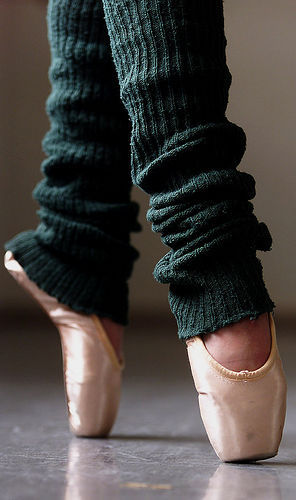
There were, as always, dancers in the group. Talking about issues with feet. They are without question in that category. ouch. One of them said when her ballet class of little girls were complaining about the discomfort, she reminded them, It's going to hurt. She wasn't being unkind. It's just a fact. If you are going to be a dancer, your body is going to feel it. And for sure, your feet.

Yet, it has always been seen as a sign of beauty and grace. It? The body, yes, but even more, the ballerina's foot.

Think about how it is shaped. How it is bound. How it moves. How it is envied. How it is admired.

With this as my backdrop, I couldn't help but think about the previous article on Chinese foot binding. And my question to you. Are we so different in the 21st century?

Let's start with the ballerina. Please know, I am certainly not being critical of these amazing artists. But I can't say I believe it's healthy for the body, in the long run. Our toes were not made to bear our full weight and walked on much less danced on. ouchy ouch. No more than the heels were made to be walked on as did Chinese women. Both are extremes. One difference, thankfully, ballerinas do walk like the rest of us when not showcasing. So their poor digits are getting some relief. But is it enough? And what is the recovery time?

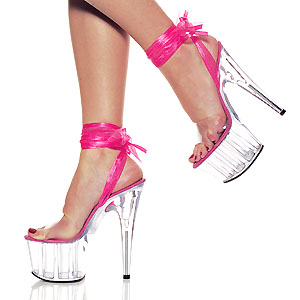
But then who are we to be critical of their desire or need to kill their feet to perform? Look at us, or most of us. We, too, have our own faulty cravings. We dance around in 10 inch stilettos, which comes close to walking on our toes. OK, OK, so 10 inches is a bit of an exaggeration. I've made my point.

Then if that isn't good enough, we go the other direction with faulty thongs. A perfect shoe for disaster. Just ask yours truly. Did I not take a debilitating fall while wearing cute little thongs while playing soccer on the soccer field?

Now, folks, that takes a huge amount of I.Q. I think there is a word for it: Air head. For those of you who don't know, the fall landed me in more ways than one. First, on the ground. While I made the goal, I didn't win the next game. You see, I injured my rotator cuff. A big no-no. And a probable full thickness tear according to the MRI. (More on that and how Pilates helped me another time.)

Heels more than 2 inches cause us to bear our weight on the balls of our feet. I read in a fashion magazine recently that high heels helped your posture; I had to laugh. What planet did they come from? Definitely one with a different anatomy. Think of it, heels throw our bodies forward. And our spine takes the beating, along with our legs. It leads to knee and back injury. Shortens our calves. Gives us aching, hurting, burning feet and toes. Good times!

Then there is the whole issue of balance. How many times have I seen people fall on their faces? Just recently, the famous Angelina Jolie en route to an event, stumbled around on her famous stilettos when gum got stuck on the bottom. And if that wasn't enough, then she ripped her hip-melted leathers right down her cute little backside. Thankfully, Brad was there to put his hand over her derriere.

Thongs/Flip-Flops are another matter. Some would think they would be better, right? Wrong. Usually, thongs have no arch support or any other proper support. The open shoe sets us up for cuts, scratches, and broken nails, which can all lead to a visit to the doctor or hospital. Again, the posture is affected. Have you noticed how you grip the thong when you walk? Or how your foot may flatten out? These simple shifts in our foot structure can inhibit proper balance and posture.

Then one of the latest crazes are the pointed, wickedly pointed toed shoes. You know the kind. You have them in your closet. And your husband or boyfriend has been deathly afraid of you since you brought them home. Every time I see them, I think of The Wizard of Oz. No, not the beautiful red slippers, but the wicked witch's shoes sticking out from under Dorothy's house. She's melting, melting.

Remember how delicate our feet are, yet what an amazingly complex system they are. Review Part 2 in the series for a simple overview of the foot's anatomy. Or do your own research.

Is it really worth it to make a fashion statement?

NEXT: Beyond shoe art, what are the latest crazes with foot cut and pasting?

Copyright © 2008 by Ellen M. Samples. All rights reserved.

Just 'Searching 4 U

So where have I been? It looks like it's been four days since I've been on the site.

Not so, folks. Actually, I'm usually blogging away (I do have a more than too many blogsites to manage!) but many of those posts/articles are deeply embedded in my edit file. Some articles happen in a rapid succession of a few clicks on the laptop, while others hang out in the edit room, savoring.

And that room is no insignificant holding tank; it's where all the good stuff happens. Where the mega research lands before it's launched before your eyes.

Off to the next flight!

Stay blogAWARE for the continuation of the foot series! You don't want to miss Part 4.


Copyright © 2008 by Ellen M. Samples. All rights reserved.

6/19/08

Just Between

OK, so a minor interruption from the foot series.

Just a quick note. I'm in the middle of another intense Pilates course. Four bumper-t0-bumper days. One day under my shoes, I mean belt. The foot series must be on my mind.

This course is on special populations. No, I don't mean the baby boomers! Special populations as in people suffering with injuries, women during pregnancy as well as post-pregnancy, people with certain illnesses, and so on. The course delves heavily into anatomy as well as the bio-mechanics of the body and rehab. So only after one day, my brain is fatigued. But a welcomed problem, if you can call it that.

The instructor is fabulous and cute to boot. He has an amazing background rooted in dance, personal training, business, and of course, Pilates. His expertise and charisma fast forwarded time on the clock.

So for the next few days, I'll be busy with my head in the books. But keep checking in, as I will keep unveiling new articles on the foot series as well. Speaking of which, check out the first three articles.

Copyright © 2008 by Ellen M. Samples. All rights reserved.

6/18/08

The Pain of Beauty: Part Three


Feet have often been portrayed as a sign of beauty. For women, anyway. Cultures have chosen unusual ways to create that image. Most of us remember seeing movies where Chinese girls had their feet bound. And not by choice. If you recall, they were bound to make their feet smaller. Thankfully, the 10the century is past. But are we so different in the 21st century?

While I started this article out with the intention of writing about the perils of our feet, my heart strings went otherwise. So bear with me.

As I began researching this issue of foot binding, my hunger grew to read more. Just a few thoughts I would like to share:

There are different theories on how foot binding became so prominent in the Chinese culture. Some say male dominance, some say it was sexually driven, others say superstitions were the cause, and some due to an empress who had clubed feet. Regardless, it lead to at least one billion, yes, I said billion women affected before the law would put a final halt to the social illness in 1911 and emancipate their feet. Imagine.

But then how can we wrap our minds around this tragedy that lasted for centuries? And to think that it became the desire and not just an involuntary act. It has been said that binding became so prestigious that to not do it was more painful than to go through the physical agony of doing it. As one author noted, binding was in some twisted way a kindness to keep them from suffering social injustices. Why? To be accepted as part of the elite rather than be take on the "look" of being poor. You see, binding was not just a sign of beauty but was equated with royalty and the rich. So a girl stood a better chance of making it socially if her feet were bound.

I've never known what a bound foot looked like, not really. How about you? What I'm going to share isn't the Hollywood image I was given (photo below). Most often small children/babies feet were bound while the bones were more pliable. When the girl didn't have them bound at an early age, their feet were broken. And sometimes this took more than one attempt. And often infection set in as well as loss of toes, and maybe even life. The goal was to make the feet 4 inches or less, very slender, and pointed.

How did they walk? Basically on the heels of their feet. Don't just imagine; stand up and walk a few steps on the heels of your feet, if you can. I don't know about you, but that was awkward. Did you notice how it affected your gait, your stride? Tiny steps? Dainty steps? That's it. That was part of why binding was held in high regard. It created the look of being ever so feminine and fragile, yet graceful in some measure. Many thought it created the look of a dancer floating across the stage.

But most of these girls and women weren't given royal status; rather they had to carry on with everyday activities, even working in the fields. Imagine living your entire life that way.

Looking at the bound foot, why would one think it was a sign of beauty? With the human eye, it looks anything but. For one, some thought the shape was similar to the private parts of the female body. I won't detail the sexual connotations.

But mostly the beauty came in the shape of the foot, and the shoe that was designed for its home. As you can see(2nd photo) the big toe was left free while the other toes were pressed toward the sole of the foot. Therein you get the pointed, slender look. And the shoe? Many times it was designed by the person who wore it. The shoes were eloquently decorated with beautiful flowers, butterflies, and the like. Ah, there was the appeal, the beauty, while the ugliness of their pain was well hidden deep beneath the ornate covering (1st photo).

The question I posed to you at the beginning: Are we so different in the 21st century? Think about it.
Until the next time we meet on our feet.

Next: Part Four. To be continued.

Photos from Google.

Copyright © 2008 by Ellen M. Samples. All rights reserved.

6/16/08

What's in a Foot? Part Two


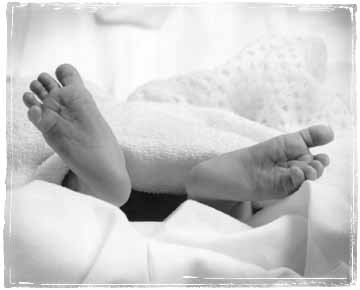
Even before entering this earth our bones are forming in the womb. Amazing. I love pictures of newborn babies feet, don't you?

But what are in those little feet? Lots of bones, muscles, tendons, etc.

To be a little more exact, the foot/ankle have:

  • 26 individual bones
  • 33 joints
  • Over 100 muscles
  • Tendons
  • Blood vessels
  • Ligaments
  • Nerves
  • Skin and tissue
Wow! There are more bones in our feet than anywhere else in our bodies.

What do they do for us? Balance, support, and give us mobility. They are our shock absorbers and propulsion engines. Think of the load they carry!

What do we do for them? KILL THEM!

Our feet work all day whether we sit, stand, run, or walk. They become the most affected part of our anatomy.

Our occupation, activities, health and more importantly our shoes affect the condition of our feet.

Just to name a few foot issues:

  • Athletes foot
  • Toe nail fungus
  • Neuromas
  • Metatarsalgia (burning in the ball of your foot)
  • Tendinitis
  • Corns and calluses
  • Warts
  • Hammertoes
  • Flatfeet
  • Ingrown toenails
  • Arthritis
  • Club feet
  • Pigeon toed
  • Plantar Fasciitis
  • Neuropathy
  • Xeorosis(cracked heels)
  • Edema
  • Gout

Three common categories of feet:

  • Flat Feet (tends to be pronated-roll in)
  • High Arch Feet (tends to be supinated-roll out)
  • Neutral (the goal)

You can have a professional to look at your feet to discover what kind you have. Or you can do a home test by putting your feet in water and then stepping on something that will give you a view of your feet (I've done that after stepping out of the pool). Also, take a look at the bottom of your shoes. How are you "wearing" them? Do you see the bottom wearing down on the inside or outside?

However, in most cases it's best to have someone who is educated on the subject to give you an opinion.

Next: Interesting facts on what's going on with our health concerning our feet, etc. Part Three
Copyright © 2008 by Ellen M. Samples. All rights reserved.

6/10/08

What's In A Shoe? Part One

When God created man, He did good. But when He created woman, He put His best foot forward.

OK, I don't mean to be irreverent. But speaking of feet. Did He really know just how many shoes Eve's ancestors were going to insist upon? And how pretty they were going to have to make their feet just to hide them in those shoes? (Besides wasn't Eve barefoot? Well, at least until the Fall.) Of course He did. He is Omniscient, you know. So you see, He had a Plan. However, I'm sure we have trotted off THE path.

I think it has a name. Addiction Drive, Valley, Street, Lane, Hwy, etc..

Yes, most of us are obsessed with not just our shoes but with our feet. We treat them like they are goddesses. We pamper them. We parade them. We 'plaud them. We picture them. We please them. You get the picture. And then we cover them up. We are ridiculous, are we not?

Do you blame us? I mean, shoes provide so much pleasure. Don't they? Well, yeah. To the people who design and sell them, that is. Like Jimmy Choo and Tamara Mellon.

But those of us who love shoes, do take pleasure in killing ourselves to wear the latest and greatest. We are willing to walk on stilts if we have to (affectionately known as stilettos). Well, providing they come in the right colors. I was going to say the right sizes, but we know that would be a magnificent lie. How many of us have crammed our foot into a shoe and swore it was our size? All for the delight of lookin', ah, gooood. Uh, huh. Tell the truth. And who hasn't flopped around in a shoe two sizes too big just to make the runway?

We are true warriors, shoe warriors, that is. Let the march begin.


UP NEXT: Part 2: The anatomy of the foot; the bare naked truth! And the answer to "What's in a Shoe?"

No Tahmahtez, Please!

Most of you are probably aware of the concerns about uncooked tomatoes. For more info, please click on tomatoes and salmonella.

6/9/08

MOVE IT OR LOSE IT

What's the common denominator with these little bodies on the move?

HINT: Stay tuned for the upcoming series on the Tootsie!

Join me over the next few days on this amazing journey on foot.

Hangin' Ten,
Ellen Marie

6/5/08

Autism and Pilates

Autism continues to hit the news (see article below). The Sunday Parade just recently had a warming article on the many facets of autism. Today, the local news reported a missing teenager. The greater emphasis? He had autism. The good news? He was found.

My heart's concerns have broadened due to having clients whose children have autism. While I have not trained any of the children in Pilates, I have been a nutritional consultant for them. Before we get into physical and nutritional suggestions, let's take a look at the face of autism.

Considering 30+ years ago autism stats were 1 in 10,000 children, the 21st century stats are alarming. According to the Center for Disease Control 1 in 166 children are living with some form of autism's daily demands. Too, we know that boys are more likely to be its choice. Why? is the clarion call. Is it genetics? Is it the mercury in vaccines? Is it in the food they eat? So many unanswered questions.

Thankfully, we have evolved into a greater sensitivity from the past. Years ago (early 1900s) Eugen Bleuler coined the name autism and claimend it was schizophrenia. In the 1940s others(Bruno Bettelheim, Leo Kanner)blamed it on what was called, "The Refrigerator Mother". Mothers of autistic children were accused of not providing sufficient amounts of interaction with their child, therefore causing the autism. In 1964 Bernard Rimland wrote Infantile Autism shedding new light and redeeming these misaligned mothers. Then came Rain Man with Tom Cruise and Dustin Hoffman giving autism the long awaited audience it deserved.

Over 30 years ago was my first encounter with autism. My fiance, at the time, was researching the subject for his degree in psychology. It definitely caught my attention. Little did we know just how profound it would hit our society and people we would come to know and love.

Pilates and Autism?
Yes, the two can work well together. While I have not had the privilege of working with a client with autism, I know that Pilates can provide a healthy piece to the puzzle.

Dawn-Marie Ickes is an example. She is a PT as well as a certified Pilates instructor and has reported positive results while working with children with autism. She found that Pilates helped with both movement transitions and environment transitions which are the two biggest challenges autistic children face. She found a way to incorporate activities to keep them organized before working on their gait-related issues and motor skills. She focused on their vestibular and proprioceptive systems as a prep activity which helped the therapeutic intervention.

She incorporated the Pilates Reformer and the jump board as well in their therapy. The Reformer helped them to focus and transition from exercise to exercise as well as giving them a sense of better balance and awareness. The jump board helped to provide a linear combination of vestibular and proprioceptive input. To read more about her findings, please check out: Pilates' Surprising Benefits, November 2006.

Please note that it is NOT recommended that an autistic child be placed under the care of just any Pilates instructor but a highly qualified professional who understands not just Pilates but autism rehabilitation.

Nutrition Therapy?

That will have to be the topic of another post. I will say nutrition, I believe, is a critical part of the solution. Which vitamins, supplements, foods, etc. to use? While I believe there are definitely certain ones that prove to be helpful, as in any case, each child is an individual with unique nutritional needs.

Let's pray for a cure. In the meantime, I hope we all find a way to be a part of the solution. Some suggestions:

  1. Be an encouragement to those whose children have autism
  2. Contributing financially to the cause
  3. Learning more about it and sharing what we know

The following is an article worth noting:
Health Highlights: April 24, 2008 - MSN Health & Fitness - Health Topics:
"Proximity to Mercury Pollution Source Linked to Autism Risk The first study to show a statistical relationship between autism and proximity to industrial sites that release mercury has been published by researchers at the University of Texas Health Science Center at San Antonio. Their analysis of data from 1,040 Texas school districts and data from 39 coal-fired power plants and 56 industrial facilities in the state showed that autism rates decreased by one percent to two percent for each 10 miles of distance from a mercury pollution source.

Among the other findings: For every 1,000 pounds of mercury released by all industrial sources in Texas in 1998, there was a corresponding 2.6 percent increase in autism rates in Texas school districts in 2002. For every 1,000 pounds of mercury released by Texas power plants in 1998, there was a corresponding 3.7 percent increase in autism rates in Texas school districts in 2002.
The research appears in the journal Health & Place. 'This study was not designed to understand which individuals in the population are at risk due to mercury exposure. However, it does suggest generally that there is greater autism risk closer to the polluting source,' lead author Raymond Palmer, associate professor of family and community medicine, said in a prepared statement. -----"

5/26/08

Up the Scales!

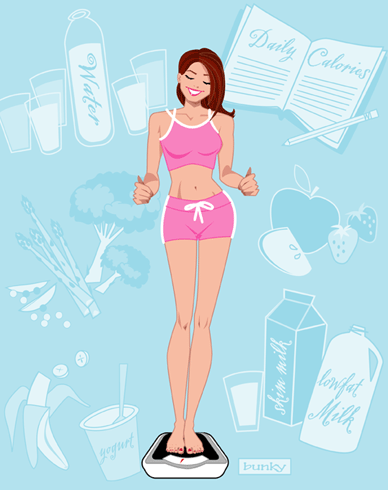
So what are you waiting for???? Help me share the greatest weight loss program available for the 21st century. Definitely the funniest. We all need a laugh. Remember laughter burns calories. Include it in your daily diet.

OK, so what's really lurking beneath my silliness today, on this wonderful Memorial Day? Something more serious.

The War on Fat

Speaking of fighting wars, have you heard of the controversy at hand over the new HCG diet? Perhaps you haven't even heard of the diet much less the controversy.

First let's take a peek at why Americans are so intent on finding the perfect pill to shed their unwanted pounds. Did you know 300,000 deaths a year occur in the U.S. directly attributed to poor dietary habits and lack of physical activity? Two-thirds of adults are overweight. We spend $33.5 billion, yes, I said BILLION dollars per year on weight management products and programs. So what's wrong with this fat picture? Why are we not the skinniest people on the planet?

What is the HCG diet?

HCG or hCG is really not new. Kinda of like Pilates. You know, it pops on the scene and everyone thinks it's fresh off the market place? You may have heard about it on the Mike and Juliet Morning Show (ABC) or in one of Kevin Trudeau's books, or maybe a friend.

Actually a British doctor by the name of ATW Simeons began researching hGC and finding great results with obese people back in 1954. His research is quite interesting. He wasn't on a money market binge; however people have abused his findings. And all for the sake of the almighty buck. The nature of man.

HCG is an acronym for Human Chorionic Gonadotropin, which is a substance produced by the placenta during pregnancy in large amounts. HCG was named in 1927 by Ascheim and Zondek after they discovered it in the urine of pregnant women. Without getting too detailed, part of its name came from gonads, because the substance had an action on ovaries and testicles. Pharmacies have sold it since 1930.

Part of the regime is to daily take the script orally or by injection. It curbs your appetite, and you limit your caloric intake to 500. Therein is part of the concern.

But proponents of it say that it not only helps you lose weight, but it reshapes your figure. It's supposed to decrease fat, and not destroy muscle as most diets have a tendency to do.

Dr. Simeons was totally against people using the diet, unless they were willing to adhere to the precision of the rules. He totally believed in its success if they followed the plan.

What happens after you come off of hCG and the diet? That's the other concern. Most people gain back weight and more after dieting. And being on 500 calories creates health questions for nutritionists as well as medical professionals. We know that if our intake of calories is low, when we start eating normal amounts again, the body's metabolism typically slows to a crawl, creating more weight gain. What you already know, right? But advocates of hCG say that's not the case with the outcome if you go by the protocol.

OK, so around and around we could go on the pros and cons. I'm merely trying to report. Now you need to do your own research.

It really boils down to what people are willing to risk. Anytime you use a pharmaceutical, you are at risk to some measure. Have you ever taken a closer look at the list of possible side effects on your drugs? Did you know that in order for a substance to be approved as a legal drug, it has to be toxic? It goes through L.D. 50 testings (Lethal dose=L.D.). I've heard some experts on the matter ask. "Can you posion yourself to health?" Good thought.

I'm not saying all drugs are unnecessary in the society we live in. But I do understand that if we gave our bodies what they needed to heal themselves, we wouldn't require drugs, at least not at the extreme levels in which we depend on them for help. That's a topic for another article.

Back to the HCG diet. Many are praising its thinning abilities. Many are giving loud voice to the fattening problems.

I am sure no xpert on this matter. So I'm clearly not advocating this program. I'm all about going green and clean. As one professional on the matter stated, "I want to see how much these people on the HCG diet weigh in five years." I'm with her.

There is no silver bullet. The gold bullet, on the other hand, might work. That being, ourselves taking full responsibility of our lives, our health. Now that's a plan for Memorial Day.

P. S. The photo: I bet I could use those scales as weights in my next Pilates leg-lift series. Talking about challenging balance and stability! Then again, I don't think I want a cracked head. Use at your own risk and for sure, do not try this at home....or any other place for that matter!

GHI Medical, HCGobesity.com, Mike and Juliet Morning Show, HCGdiettips.com

5/25/08

Vote for Jennifer, not D.P. today!

So are you watching the Indy today? We went to see Indy last night at the Cine-Capri, only the largest screen in DFW!! Awesome.

Oh, but we're not talking about that Indy? Which one then? Oh, Indy 500. I know you'll never guess who they say will be the center of attention? Wonder why! I know it's because of her figure (no, not her income). She got it from Pilates. Way too much time on reporter's hands...and minds.

Really, I am posting to ask you to please clk on: http://www.ideafit.com/health_fitness_video_contest/ContestVideos.aspx and vote for Jennifer Griffin. She is the lady I posted about in March (check it out in the achieves) who came down with a sudden illness (sepsis) and nearly died. Just check out her video and please vote! You will need to scroll down past the first entry whose name just happens to be Jen as well. Scroll til you see Jennifer Griffin/Pilates.

After all the hoopla about D.P. this week, it's refreshing to see a beautiful woman like Jennifer being a model/example for young and old...by using her mind and not her body. She's my choice to be in the headlines. I salute you, Jen!

The photo was taken from the article in the Dallas Morning News. Visit Jen's blogsite at http://www.getwelljen.blogspot.com/
Thanks.

5/23/08

Racing or Racy?????

In relation to the previous blog:

OK, so more articles about Danica Patrick. Goodness. Is she really all that? Looks like it's up for debate. Check it out at:

http://msn.foxsports.com/other/story/8161426/Focus-should-be-on-Patrick

What do you think?????????

5/21/08

The Indy and Pilates

No, this is certainly NOT Harrison Ford. Hummm, wonder what he does to stay fit? Pilates?

What I am referring to is:

My brother, who is an avid Racing fan sent this to me! Hooray for Danica Patrick in more ways than one! You should check out the articles on her under Motor Sports at http://www.usatoday.com/ For sure, to be a race car driver, you have to be well-groomed physically as well as mentally.

OK, so she doesn't look like your average race car driver. Is that why my big bro was checking her out, well, I mean the article of course. Just kiddin', Bro! No worry, folks, he is very in love with his beautiful wife of almost 40 years.

By the way, one of my closest female friends is a race car driver. Hi, Ang, you go, girl! varoommm *********************************************************************************
Ellen,
Was reading USA Today Tuesday's USA Racing Star Danica Patrick who will be in the second row of this week IRL IndyCar Indianapolis 500. She is 26 years 5" 1 and weighs 110 pounds.

She was asked, "How do you stay fit for racing?"

"I work out daily. My workout is a balance of building strength - especially upper body strength - and stamina, endurance. I use free weighs, and I do running, yoga and Pilates."

Cool!

Lov ya,
Charles

5/19/08

5 Principles of Alignment Revisited

1. BREATHING.
Pilates breathing takes a little practice! Inhale through your nose and exhale through your lips/mouth. Laterally. Think of breathing in, around, and through your ribs (back and front) allowing them to expand like an accordion. You should feel a little extension in your spine. On the exhale allow the sides of your ribs to draw toward each other. You should feel a little flexion of the spine. If your shoulders are rising up and down, your breathing is too much in the upper part of your lungs/chest. And if your belly is rising and falling, you are not breathing correctly. Belly breathing doesn't usually protect the lower back. Too, be careful not to hyperventilate! If you are not used to deep breathing, as most people aren't, you may feel a little light headed. Take your time. Practice on and off throughout your day; it will make a difference. Why is proper breathing crucial in performing exercises as well as in your everyday activities?

  • it releases oxygen into your blood
  • it releases oxygen to the cells of your muscles
  • it cleanses and aids digestion
  • it provides the energy you need while performing a task or exercise
  • it helps your mind to find clarity and to focus on each task
  • it activates the deep abdominal muscles/the core
  • it brings life into your body-after all, it is the first thing you do when you are born!
CUE: Think of inflating and deflating your ribs like a bellows or an accordion. Three dimensional.

2. CERVICAL AND HEAD PLACEMENT.
Most of us walk, stand, and sit with our heads forward instead of neutral. Take care that you don't hold your head and chin up too high, no sky gazers. Don't allow it to drop to your chest like you are snoozing in your favorite recliner! Bring your head back to where your ear lobes line up with the tops of your shoulders. Lift your head and lengthen your neck as though someone is gently pulling you up, up, up from the top of your head.

In Pilates we practice and use cranio-vertebral flexion (aka head nods) to demonstrate the principal of head and cervical placement.

CUE: To perform a proper head nod, pretend you have an apple or a small fist between your chin and chest, not letting your chin fall into your chest. No jamming. The move is ever so small. The axis and atlas are the two main cervical vertebrae at work.

3. RIB CAGE PLACEMENT.
Soften the ribs, keeping them from protruding. You might notice having a problem with the ribs "popping" when you are raising your hands and arms above your head while seated or lying or standing.

CUE: If you can, gently place your hands on your ribs and remind yourself to soften.

4. SHOULDER/SCAPULA PLACEMENT AND STABILIZATION.
Some of us have a rounded back (kyphosis), some more straight back, some sway back. The goal is to not wear your shoulders like ear muffs or hold them back like you are in military stance! Choose rather to bring the shoulders back and then allow the scapula/ shoulder blades to slide back and down.

CUE: open or broaden your chest, and allow your shoulder/scapulae to slide back and down.

5. PELVIC PLACEMENT.
While on the mat in a supine (on your back) position, allow your pelvis to tilt so that your lower back is imprinted into the mat, while not lifting your tush off of the mat. Then allow the pelvis to tilt the opposite way. Ah, Elvis, the Pelvis move! Between these two points is what we call neutral. With most people there will be a small space between their lower back and the mat while in neutral. And while neutral is a goal to work out of in Pilates, we often work out of imprint while we are learning and developing stronger abdominal muscles and overall strength. Usually if our feet and legs are raised up, we work out of imprint so that we don't place undue pressure on/in our lower backs.

CUE: when you rock your pelvis back and forth, your neutral pelvis will be found somewhere in between the two positions. You can also think of a cup of tea resting on your lower belly where your pelvis is and find a safe position where it's not tipping over. Keep it square and level.

All of these take practice, so why can incorporate them into your everyday activities. Your body will love you for it. If you are not sure about the particulars, please give me a call or email me. Or seek the help of another professional. Just do it!

5/7/08

How Long in the Body Shop? Part Nine

Great question. I am certain what you are really asking is, How long will it take to bring balance into your unique body type? Until the day after forever maybe?

OK, how about something more reasonable like as long as you are breathing and having birthdays? That sounds about right. Friends, we will always have to make body corrections unless our bodies quit devolving. And that is not likely. If that news is disruptive to your positive mind control, don't despair, there is hope.

****The good news is with every correction, no matter how small, you breathe life back into your body. With every correction you will diminish the aging process. While we can’t beat the clock, we can carve away bad habits by sowing good seeds of correction into our bodies.

A good example is little Mama. While her body continues to show wear and tear, like it or not, she is not totally helpless. With every little raise of her head, and or her shoulders, she delays and defies the beating hail storms of life.

Caution: The longer you wait to get the broken down vehicle (we all have them) in the body-shop, the longer and harder it will be to get the engine going and running smoothly. And it does come with a daily (taking it in every 5000 miles and or 6 mos just won't do)maintenance/prevention plan; so use it. That is, if you want to prevent blowing up your engine. Now that would be a nasty sight. I know you don't want to leave that kind of mess for your family to clean up! ugh


So off with the old and on with the new. Slide your way into that sleek new body style of yours and watch the envy grow all around you.

Following are some suggestions:

  • Get a proper body assessment from a qualified source. Make sure they view your posture from the front, back, and side.
  • Request a guide/plan for your individual body's needs.
  • Apply, apply, apply and then apply-4-life.
  • *Pilates is a key player for my clients in body recovery, so I would highly recommend finding a qualified Pilates instructor and asking him/her for help.
  • And please remember this is a lifetime project that will bring you lifetime results. I know you would prefer your body to end up as a sought after collectible rather than landing in a crumpled pile of epidermis in the junk yard.
  • *I would highly recommend learning the 5 Principles of Alignment. I will re-post those for you. Practice them in your everyday life.
  • Get frequent body checks. Pay attention to your body. Give permission to someone you trust to gently cue you if you are getting body sloppy.
  • Send your muscles the right info. They do have memories. What you teach them will reflect in your posture and in your health.
  • And SHINE, SHINE, SHINE!!!!!!


If you have any questions, please feel free to email me or leave a comment.

Where Did You Get That Body??? Part Eight

It's called birth. That's all it takes. And out pops a body with over 300 bones. Amazing. We are born with certain bone structures, and tendencies toward certain types of body mass. While I weighed in over 10 pounds at birth, I grew to naturally be tall and thin. I do not have a large bone structure, nor do I naturally have large muscles or for that matter medium ones! Small ones? Let's hope so! I have friends who are shorter and easily build muscle. And what do we do? Usually sit around wishing we had what the other has. Humans are funny, are we not?

Think of our teeth. What do teeth have to do with body types? They are a genetic combination of our parents. We don't get to decide how they are going to grow in our mouths. That’s not to say we can’t correct in part and sometimes maybe in whole. With our teeth, we know the face of correction typically looks like braces and or surgery.

But our posture demands greater attention and maintenance/follow up in order to find its correction. The greater exam /challenge is to gather info, then draw that education into our bodies. What was it that Princess Di always said, "Knowledge is power.” Helplessness leaves and empowerment arrives.

And, then, yes, we by our very nature affect what we are innately given. That usually occurs as soon as we come out of the womb, though in small doses. Then enter our caretakers. They are our models. We are their echos. They teach us how much to eat, what to eat, etc.. Ahhhh, so let's leave it there and blame it on them. We can, but that no workie, at least not in my class. Do we need to discover what birthed our habits? Might we need to forgive well meaning folks for being an unhealthy catalyst ? I would say, without question!!!

Looking at our own personal choices in the process is paramount in recovery. Or we can wallow in the dysfunction of the past. We choose. Oops, this is starting to sound like a therapy session. (Can't seem to help it, I was a crisis counselor for about 7 years.)

How Do We Affect Our Posture?
We have elected to eat too much or not enough, or both. We have decided not to exercise enough, and, or too much. Think about it, if our body is too heavy or too light, adjustments occur. We have taught our muscles to perform in ways that greatly damage our posture. The list goes on. You get the idea.

Any or all of these can destroy our posture. They influence the way we walk, run, sit, stand or even the way we work or play sports. Most of us don't know how far reaching the damage is until an issue speaks up. Example: my mother's kyphosis didn't just happen; it developed gradually over many years of improper body alignment.

So why not begin now with taking a look at ourselves in the mirror.
While we are working on healthier lifestyle habits with our weight, etc., we can begin to posture ourselves into looking better every day. How? It's pretty simplistic; it won't cost a thing, and it's calorie free. Now that's a deal.

Simple Suggestions:

  • Begin by sitting up taller, standing up taller.

  • Lift up your head as though someone is pulling you up from the top of your head.

  • Draw your shoulders/scapulae back and down (no ear muffs, please).

  • Engage your core (pooch time).

  • Lift up from your torso (stack your ribs instead of crunching them over and down). Remember your ribs are there to protect your organs, not suffocate them.

You just dropped 10 pounds! I know you have to feel better, and I can promise you, your organs greatly thank you.

NEXT: Part Nine in the Body Adjustment/Awareness Series, How Long Will My Body be in the Shop?

Attention! Part Seven


Wow! No posture graphic. Aren't you happy? It's time for us to move on past the actual types and discuss how we came to have these bodies, are we stuck with them, what do we do with them, etc. Did you see yourself in any of the types?

But before I head on into the next chapter, I am briefly going to go over the Military Posture. since I did mention we would looking at it.

We seldom see the Military Posture, so I'm not going to detail it like I did the others. And you may have noticed, it's not even on the posture graphic. In most posture curriculu, it's not included.

Military Posture

  • Head neutral
  • Cervical spine- normal curve, slightly anterior
  • Thoracic Spine-normal curve, slightly posterior
  • Lumbar Spine-hyperextended lordosis
  • Pelvis-Anterior Tilt
  • Knee Joints-hyperextended
  • Ankle Joints-slightly plantar flexed

As you can read, this posture has issues as well. While I don't have a picture for you, exercise the right side of your brain for a minute! I bet you can get a visual by picturing, say a movie, where the troops are lined up and postured to meet the general! Guarantee you there won't be any slouching going on there!

A recent movie you may have seen is Annapolis with James Franco. Who, by the way played in the Spider Man series, and Flyboys to name a few. You just never know what you might learn on this blog. Kidding! Anyway, he was in the Annapolis Naval Academy. If you haven't seen it, go check it out, and take a gander at...James. Just kidding, even if he is cute. Really though, you'll see plenty of military posturing.

Or you may remember some old military movie, say with the Duke in it! Or how about none other than good old Gomer Pyle! How fun was that? If you are 25 and under, you may not know what in Sam Hill a gomer pyle is. And, no, Gomer is not about Hosea's harlot wife in the Bible. Then that may be unfamiliar as well. I think I need to take heed and stop.

OK, OK, I think you get the idea. And if the military wants service men and women to have that stance, I ain't about to correct it. I will say, I have noticed that most people who come out of the military shed the posture.

Duty calls, see you in the next post!

NEXT: Part 8 in the Body Adjustment/Awareness Series, Where Did You Get That Body?

5/5/08

Just Flat Out Get Mobile! Part Six

OK, are you about done with the posture graphic? You should have it memorized by now.

Let's move on to:

Flat-Back Posture (3rd from the left)

When I think of the Flat-Back, I think of the need for flexibility. Remember the Sway-Back person? They typically have a high dose of flexibility. Opposites! Wonder if they attract? Just kidding.

The Flat-Back type needs to take note of the oak tree! You know, it bends in the wind so it won't blow over. Whereas we can't always keep the Sway-Back person from blowing in the wind, (hey sounds like a good title for a song).

I've had the privilege of teaching a duo with both of these types. Now that can be challenging because of the vast differences. Which means different modifications for the same exercise. Ex. A sway back person may have a hard time balancing themselves on their sides while performing the side leg series while the FB will not. The flat back may have a harder time performing a roll up while the SB glides right up. I think this duo worked out well together, for many reasons. For one thing, they saw up close and personal that none of us are exempt from personal challenges.

It's amazing how well our bodies will and can respond to change. We sometimes feel overwhelmed with the battle before us. Yet, there's always the hope that we will overcome. While we can tap into a variety of cosmetic surgeries, I think the only real answer for our body issues is to roll up our sleeves and get busy. And as Joe Pilates said, even 10 minutes of Pilates a day would make a difference in our health in 30 days. How can we pass that up? And it's all free. No calories, except those we burn. Sounds like a deal.

Flat Back Posture Characteristics:

  • Flat Back Head is forward, Cervical spine slightly extended

  • Thoracic spine- upper thoracic is flexed and lower part is straight

  • Lumbar spine-flexed straight

  • Posteriorly tilted
  • Knee Joints-not hyper-extended but extended knee joints

  • Slightly plantar ankle joints
Pilates?
In Pilates one goal is to help them become more flexible as they typically do not have a lot of mobility. We use a series of exercises with flexion to help them with the flatness in their mid-thoracic and extension to help them with the lack thereof in their lumbar.

One example on the mat is Rolling Like A Ball. And Cat is great. In the case of Cat, they are getting both flexion and extension. Flexion as they bring their tailbone and head down/toward the body, arching the back. And extension when they bring their head and tailbone back up/away from the body. Click http://www.pilatesworx4life.com/, then click on the Packages Page to see an example on my website of a man in flexion while performing Cat. Notice how his head and tailbone are heading toward each other.

In case you are wondering, I think of flexion as the act of moving toward the body. Extension, moving away from the body.

Homework: Again, I would say have someone take a snapshot of you from the side with your phone or camera. Take a look and see where you are in space. Is your head forward, your upper and lower back flattened, which way is your pelvis tilting, are your knees extended? Now making note of these try self-correcting your posture. Simple awareness makes a huge difference. Though simple, it may not be easy. Retraining your muscles takes time and energy.

Along with awareness, I would recommend you work on becoming more mobile. No, I don't mean using your phone more often! Really! It's called flexing your spine. Stretching would be helpful as well, and on a daily basis.

Try flexing forward off the wall. Step a foot or so away from a wall. With your arms about shoulder distance apart and extended in front of you, begin to round over SLOWLY, allowing your arms and head to follow. Control, control, control. Only go as far as you can maintain balance and control. Then being to unfold slowly, returning to your starting position. Vertebra by vertebra as best as you can so as to bring mobility to your spine. And remember to breathe, Pilates style. Go back and read my post on Feb. 21 on the 5 Principles of Alignment. Check out #1 Breathing. Go easy at first, then repeat about 5-10 times every day. Practiced every day over a period of time, and you should begin to experience more flexibility in your spine.

Caution: If you have vertigo issues, you might try to flex forward while sitting in a chair.

****Again, I highly recommend you find someone who is qualified to do a body assessment.

NEXT: Where Did My Body Come From? Body Awareness/Adjustment series, Part 7

5/4/08

Just Swaying Along, Part Five

Sway Back Posture

The Sway Back body type may have as many challenges as the Kyphosis Lordosis person. Avoiding redundancy, I won't be detailing areas that are similar to the previous K.L. post. You might want to review the homework sections in that post for more information. You will notice the head is forward in both. The thoracic spine has increased flexion. And there is often hyperextention of the knees. Notice they have a posterior tilt. And as I will mention later, they are much more flexible.


While looking these over, see if you can spot the differences in the postures. Too, look for the following Sway Back challenges:

  • Head is forward. Most have a slight extended cervical spine.

  • Thoracic spine has some increased flexion/ long kyphosis.

  • Displacement of upper trunk posteriorly.

  • Lumbar/lower back is flexed or can be described as flattened.

  • Posteriorly tiled pelvis which can give the appearance of a flat tush!

  • Hyperextension in the knee joints.

  • Ankle joints may have plantar flexion, but in some cases may be neutral due to the anterior deviation of the pelvis and thighs.
Typically they are more flexible than other body types. Our main goals with the sway back are to bring openness in their shoulders and chest area along with teaching them to control their flexibility by bringing stability into their body. While the K.L. person has more than a healthy measure of extension in their lumbar, the S.B. struggles with too much flexion. Therefore, increasing extension in the lumbar is greatly needed.

HOMEWORK: As with the Kyphois-Lordosis posture, have someone take a picture of your profile, making sure you don't "correct" your stance. Note the position of your head and neck, upper back-thoracic, lower back-lumbar, pelvis, knees, and ankles are. How does your body line up or not? Do you see any of the above postures that resemble your body? Have someone you trust take a look and give you some input. Please know that I'm not advocating doing this all on your own. Nothing beats a professional touch. I'll be addressing that in a later post.

Pilates 4 Swaying

In the slightly extended cervical spine and head forward? Awareness. Simply noting and showing your client what it feels like to place their head on top of their body makes all the difference in the world. I like to use cues as well. That's not to exclude the importance of specific exercises.

Opening up the chest and bringing the shoulders back and down are similar to the Kyphosis posture. Again there are many Pilates moves that are conducive to retraining those faulty muscle movements.

Their lumbar is given attention by creating exercises that provides extension.

Their posterior tilt is redirected! Again awareness is a key. We can begin to self-correct by simple awareness. As an instructor sometimes just helping them see where their pelvis is makes a huge difference as well as tactically correcting it, if allowed. I say allowed as some people are not comfortable with being touched. And when I say touched, of course I mean appropriately! I've found that most people welcome the help. For me, the tactile helped me "get the feeling" of what my body needed to be doing in space to be healthy.

Hyperextension of the knees are addressed similarly as with the K.L. person. Review that section in the previous post as well.

Homework: Until you can find someone to help you whether it be a chiroprator or a Pilates insturctor, try self-correcting your posture. Make yourself aware of where you are in space while you are sitting still and or moving. Think. And think some more! Remember Pilates is intelligent exercise. Review my post on The 5 Basic Principles of Alignment (Feb. 21). And then for simple recall view the list on the sidebar.

Once again, the Pilates exercises we use are performed on the mat as well as the equipment. Hopefully, your Pilates instructor will tailor your routine. If not, request it or find a different Pilates professional who will accommodate. Believe me, a true Pilates trainer will be willing to more than meet your personal needs.

NOTE: In photo above from left to right:
A. Ideal Alignment, B. Kyphosis-Lordosis, C. Flat-Back, D. Sway-Back


NEXT: The Flat Back and Military postures. Part Six in the Body Awareness/Adjustment Series